If you own a home in Montgomery, Chester, or Bucks County, your mature structural plantings are a major financial investment. Planting dogwoods, boxwoods, and arborvitae gives you more than just curb appeal. These focal points make neighbors slow down when they drive past, establishing the prestige of having the nicest lawn on the block. However, protecting your yard means working against a harsh reality.
Your suburban backyard is nothing like a natural forest, and your trees and shrubs pay the price. While wild woody plants thrive in loose forest soils insulated by decomposing leaf litter, the modern engineered yard starves them of the exact nutrition they desperately need.
That is why we built our tree and shrub protect and feed program specifically for Tri-State soil. Operating on the philosophy that we treat your property as if it were our own, we deliver the exact regional care your landscape needs to survive Pennsylvania clay and local pests.
Why Your Landscape Ornamentals Are Starving in Suburban Soils
The main problem with maintaining plant health hides right beneath the surface. When you rake up leaves every fall, you permanently cut off the one natural feeding cycle those plants depend on for food. The health of your shrubs continues to decline as they fight a losing battle against dense turfgrass.

Turfgrass covers the surface like a thick sponge. If you aren’t properly feeding and maintaining your turf, it aggressively steals water and surface-applied fertilizer long before they reach deeper woody roots. This grass barrier leaves ornamentals vulnerable to environmental stress across neighboring communities in Delaware, Lancaster, Lehigh, and Berks counties.
The way soil forms in our region creates massive physical barriers for roots. Montgomery and Bucks counties sit on heavy clay soil types, like the Bucks and Neshaminy soil series. Closer to the Delaware Valley, properties sit on dense, settling silt.
Dragging a heavy soil probe through baked Pennsylvania clay is an exhausting physical reminder of just how impenetrable this earth becomes by late August. These specific soil structures are prone to severe compaction (soil particles pressed tightly together) from residential home construction and heavy riding mower traffic.
A soil management fact sheet by the Rutgers Cooperative Extension shows how this continuous pressure squeezes the macropores (large air spaces between soil particles) out of the dirt. This physical squeeze drives up the dry weight of the soil and severely limits water from soaking into the ground.
We measure this damage in the field using a static cone penetrometer (a tool that tests soil hardness). If the tool reads 300 pounds per square inch (psi) near the surface, or when a standard wire flag bends before penetrating four inches into the earth, the soil is severely compacted. It becomes a hostile place for plant roots.
This suffocates tree feeder roots, which need atmospheric oxygen to breathe. Without natural organic matter breaking down, or a proactive approach to Terra will give your trees and shrubs the TLC they deserve, the soil loses its physical and chemical ability to hold onto necessary nutrients.
What this means for your yard:
Compacted suburban clay acts like concrete. It locks out air and water while shallow turfgrass steals all the surface nutrients. Without professional help beneath the surface, your high-value ornamental trees slowly starve. This leaves them completely defenseless against regional weather swings.
The Two-Pronged Approach to Tree and Shrub Care
Fixing what compacted Pennsylvania clay and aggressive turfgrass do to your trees and shrubs is not a one-product problem. The soil issue and the biological threat are two separate challenges. Each one needs its own targeted answer.
Traditional tree and shrub fertilization using surface granules fails deep-rooted woody plants. The nutrients simply never make it past the top layer of grass. Getting food past compacted Pennsylvania clay takes more than a bag of mix from the hardware store. Our approach to managing the health of your woody plants has two distinct parts: feed the roots directly beneath the surface, and protect the plant internally.
Feed Concentrate and Slow Release Feeding
Most of a tree’s nutrient-absorbing roots spread out horizontally in the top 12 inches of soil. The absolute peak density occurs in the exact 2 to 8-inch depth zone where the delicate feeder roots live.
Our certified technicians use heavy-duty hydraulic equipment connected to a specialized sub-soil injection probe. We manually drive this probe into the ground at calculated intervals around the root zone. A precisely calibrated feed concentrate is injected under pressure directly into the soil.
This method delivers specialized slow-release feeding (giving nutrients gradually over an extended period). It physically bypasses the thick grass roots at the surface. This puts nutrients into a liquid form that the roots can absorb on contact. It makes them immediately ready for the plant to use without waiting for rain to break down dry granules. We monitor the exact quantity delivered to match the canopy diameter perfectly, ensuring the formula is properly diluted for safe absorption.
Store-bought granules left on the surface often turn into gas and escape into the air. They also wash away into municipal storm drains during summer rain. Best of all, the sheer hydraulic pressure of our liquid injection micro-fractures the surrounding compacted clay. This instantly loosens the dirt and provides long-lasting improvements in oxygen flow.
Deep-root liquid injection delivers an exact dose of nutrients straight past the aggressive grass line. It physically breaks up hard clay beneath the surface. This gives your plants immediate access to food while restoring the breathing room their roots need to grow.
Internal Systemic Defense
Feeding your tree solves only half of the puzzle. Ornamentals, including fruit-bearing landscape trees, must be actively shielded from regional pests, boring insects, and fungal pathogens.
Modern insect control works from the inside out using a method called endotherapy. This means the plant absorbs protection directly through its root system or lower bark. When a dual-action formula containing active ingredients like dinotefuran or imidacloprid is injected directly into the root zone or trunk, the plant takes it in. The tree’s own vascular system then carries it upward.
Trees naturally draw water upward as moisture evaporates from their leaves (a process called transpiration pull). This suction pulls our protective treatment evenly into the canopy.
Any sap-feeding or leaf-chewing insect that tries to attack trees ingests the compound and dies. This target-specific method avoids the drift risks of spraying a broad canopy pesticide that could harm beneficial insects or wash away in the rain.
These internal treatments provide long-lasting protection against pests for up to 12 months with just one application. This stops new infestations from ever taking hold. It reliably knocks down listed insects like emerald ash borers, Japanese beetles, aphids, and other invasive insect species. The precision required to execute this connects directly to our team’s 15+ years of in-house golf-course agronomy experience, with dosages perfectly calibrated to the trunk diameter.
Defending Against Tri-State Pest and Disease Pressures
Our region sits in the United States Department of Agriculture (USDA) Hardiness Zone 6b to 7a, where hot, humid summers cause local pest populations to explode. To protect your yard, we base our seasonal protocols on integrated pest management concepts and local plant health care guidelines documented by the Penn State Extension. This scientific approach ensures we catch Tri-State plant diseases and invasive threats early to preserve your structural plantings.

| Ornamental Plant Category | Primary Regional Threat (Pest/Disease) | Defining Visual Symptoms & Damage Signatures |
|---|---|---|
| Boxwoods (Buxus spp.) | Boxwood Leafminer (Monarthropalpus flavus) & Boxwood Blight (Calonectria pseudonaviculata) | Leafminer: Puffy, blistering leaves and orange spotting. Blight: Sudden leaf drop, rapid twig dieback, and distinct black longitudinal streaking on green stems. |
| Arborvitae & Junipers (Thuja & Juniperus spp.) | Bagworms (Thyridopteryx ephemeraeformis) & Scale Insects | Bagworms: Cone-shaped silk bags hanging from branches covered in dead needles. Scale: Inner canopy yellowing, sticky honeydew residue, and black sooty mold. |
| Dogwoods & Lilacs (Cornus & Syringa spp.) | Powdery Mildew & Borers (Dogwood borer, Lilac/Ash borer) | Powdery Mildew: White, talcum-like fungal coating covering upper leaf surfaces. Borers: Structural boring holes, sawdust-like frass, and branch dieback. |
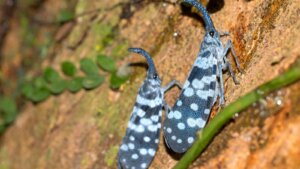
| Oaks & Maples (Quercus & Acer spp.) | Spotted Lanternfly (Lycorma delicatula) & European Chafer / Oriental Beetle | Spotted Lanternfly: Swarms of hopper insects, weeping sap, sticky honeydew, and black sooty mold. European Chafer: Spongy turf and C-shaped white root grubs. |
These different pests require careful timing based on their seasonal life cycles. When invasive species attack trees, they cut off the internal vascular pathways. For instance, aphids and scale insects rapidly drain energy reserves here in the east. If left unchecked, the subsequent spread of fungal spores can permanently reduce a plant’s structural integrity.
Our technicians who handle regional insect threats see these issues daily on local service calls. During a recent visit to a property in Blue Bell, our manager, Scott, identified an early-stage boxwood leafminer infestation that a homeowner mistook for winter burn. Drawing on his agronomy degree and 25 years as a certified ornamental horticulture applicator, he applied a targeted subsurface treatment that dissolved into the soil to save the high-value perimeter hedge from defoliation.
The Terra Difference: Why a Strategic Program Outperforms DIY Kits
Many local hardware stores market granular mixes, generic surface sprays, and solid spikes to well-intentioned property owners across the country. But the science is clear: what you buy at the hardware store was not built for mature trees growing in suburban clay.
Retail spikes create a hyper-concentrated pocket of nitrogen as they break down. If a delicate feeder root grows into this pocket, the high salt content sucks the moisture right out of the plant (a process known as osmosis). This causes severe chemical root burn. Roots located just a few feet away receive absolutely zero benefit.
Homeowners who simply pour a generic liquid pesticide or spread surface granules over compacted ground often watch the active ingredients wash away with the next heavy rain. This fails to reach the roots while risking runoff into local storm systems.
Evaluating Slow-Release Fertilizer vs. Professional Injection
Some homeowners try commercial shrub products from big manufacturers like Bayer or retail BioAdvanced tree formulations. While the boxes promise a good product, immobile surface granules bind tightly to clay particles. They rarely reach the deep root zone.
Surface-applied slow-release fertilizer options might look like a solution that works great for shallow turf grass, but they fail larger ornamentals. Properly diluted professional liquid applications avoid surface lock. This ensures the target material penetrates down through the soil evenly without causing environmental harm.
Protecting the trees and shrubs you have invested years growing takes professional-grade equipment and regional chemistry. Founded in 2003 as a family-owned and operated business, Terra Lawn Care Specialists relies on an internal management team featuring a resident agronomist with 15 years of elite golf-course experience.
We enforce a strict no-subcontractors policy. Our 100% state-certified technicians across PA, NJ, and DE perform every application. That elite level of care translates into a 95% client retention rate year over year, dwarfing the 70% industry average. We treat every client’s property with genuine care, securing the long-term health and aesthetic beauty of your yard so you can confidently maintain one of the nicest lawns on the block.
“I can’t say enough great things about Terra. I’ve trusted them with everything from general landscaping, lawn fertilization, tree removal, hardscaping, and more for both my primary residence as well as investment property. They are fairly priced, responsive, reliable and the work they’ve done has always been exceptional. The members of their team with whom I’ve dealt (Fred, Scott, and Kristin) are the best. They’ve earned a loyal customer for life and I’ll never deal with anyone else. Thanks, Terra Team.”
Ready to Stop Guessing and Start Protecting What You’ve Built?
Your yard is a major property investment. It deserves a scientific defense against hard soil and invasive bugs. We build strong customer relationships through upfront diagnostics and reliable, honest service.
Reach out to our local team to schedule your free on-site landscape health evaluation. We will personally assess your trees and shrubs for soil compaction, pest pressure, and nutritional deficiencies specific to your property. Then, we will walk you through a tree shrub protect and feed plan built around what we actually find, not a one-size-fits-all package.
For homeowners who want total coverage, pairing this program with our 6-Step Lawn Care Program ensures your turfgrass and your ornamentals receive the same level of calibrated, professional care from the ground up.