You walked outside on a July morning and found it: a rough circle of dead, tan grass replacing what was a dark green lawn two weeks ago. Your first instinct was to drag out the hose. That’s the wrong move.
Across Pennsylvania’s Montgomery, Chester, Delaware, Lancaster, Berks, Lehigh, and Bucks counties, and throughout New Jersey and Delaware, brown patches on lawns in summer are among the most misread problems a homeowner faces. The damage looks like dehydration. It usually isn’t.
More water on an active Rhizoctonia infection (the fungus behind classic Brown Patch disease) isn’t a remedy. It’s fuel. The high-humidity nights of a Tri-State summer, where temperatures hold above 68°F and heavy dew sits on grass blades for hours, give lawn disease exactly what it needs to spread.
The Tri-State Summer Perfect Storm: Heat, Humidity, and Fungal Spores
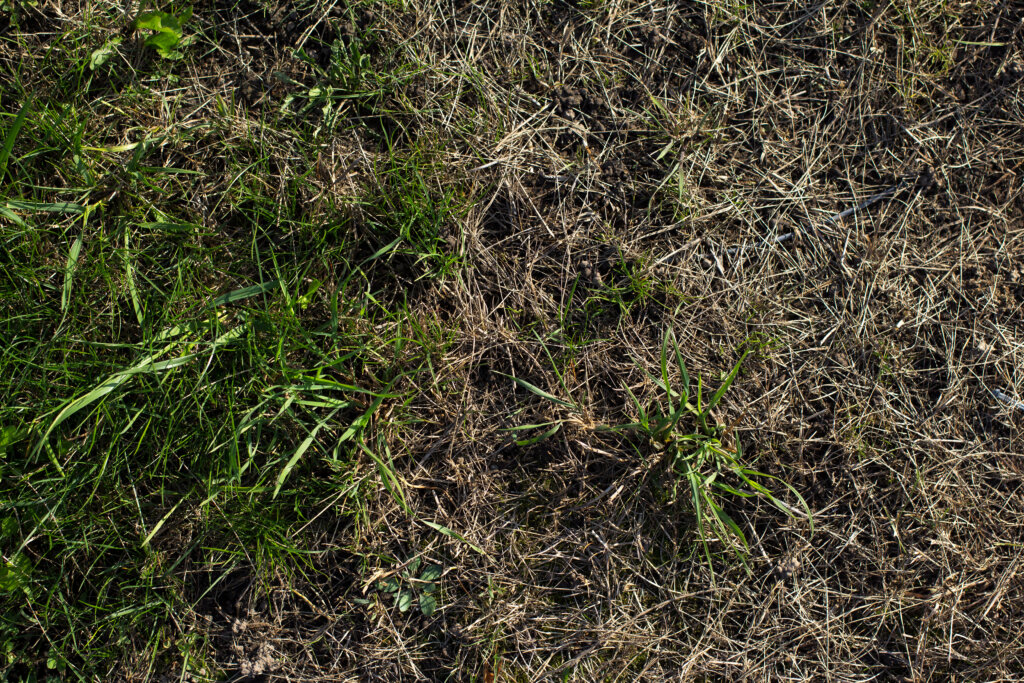
In July and August across PA, NJ, and DE, the most common cause of circular brown dead zones on residential lawns is Brown Patch disease, a fungal infection triggered by the region’s specific combination of heat, humidity, and overnight moisture. It is not a drought. It is not a watering deficit. And it gets worse, not better, when you add more water.
Brown spots don’t all come from the same place, and getting the diagnosis wrong wastes time and accelerates damage. The full picture includes fungal disease, white grub damage, summer drought dormancy, pet waste, and heat stress. Each demands a different response. Applying fungicide to a grub infestation does nothing. Irrigating an active Brown Patch infection makes it spread faster, and trying to patch the dead zones by simply tossing grass seed on top of soil will fail if the underlying issue isn’t resolved.
Why Hot Weather Triggers Lawn Disease
Cool-season grass types, including Tall Fescue, Kentucky Bluegrass, and Perennial Ryegrass, grow best when soil temperatures sit between 60°F and 75°F. Once daytime temperatures push into the high 80s and 90s during the hot weather that settles across Chester and Lancaster counties every July, the plant shifts into survival mode. Growth stops. Resources get redirected.
That stress response is normal. What most homeowners miss entirely is what’s happening in the thatch layer (the dense mat of dead and living grass material sitting just above the soil) at the same time.
How Rhizoctonia solani Starts Brown Patch Disease
Rhizoctonia solani doesn’t blow in from somewhere else. It already lives in your soil. It overwinters as hardened resting structures called sclerotia, embedded in the thatch layer and upper soil profile, viable for years without a living grass host.
When the Tri-State summer delivers nighttime temperatures above 68°F and daytime temperatures averaging 80°F or higher, those dormant sclerotia germinate. Rainy weather and a saturated atmosphere accelerate disease development fast: prolonged wetness from rain or heavy dew keeps the canopy saturated for exactly as long as the pathogen needs to spread.
According to Penn State Extension’s research on brown patch and Rhizoctonia solani, disease severity is greatest on lush, heavily irrigated turf maintained with high amounts of nitrogen fertilizer, conditions that are common across Tri-State residential lawns through July and August.
Fungal enzymes break down the epidermal cells and cut off the plant’s vascular system. The grass dies from the inside out, and what you see are rapidly expanding circular dead patches that appear overnight. If you wake up to a new brown circle after a hot, humid night, the fungus has been active for 24 to 48 hours already. Every hour spent watering instead of calling for a diagnosis is time the mycelium (the thread-like network of fungal growth spreading through the thatch) uses to expand.
Why Evening Watering Makes It Worse
Running irrigation in the late afternoon or evening keeps grass blades saturated for 10 to 14 hours, exactly the window Rhizoctonia needs to multiply. Extended leaf wetness overnight is one of the leading causes of fungal outbreaks in Tri-State lawns, and evening irrigation is the most controllable driver of it.
Residential developments across southeastern Pennsylvania are frequently built on heavy Neshaminy clay soils: slow to drain, with an impervious sub-layer near the surface. This is particularly common across older housing developments in Delaware County, parts of Chester County along the Route 30 corridor, and suburban Bucks County. When a homeowner overirrigates, water doesn’t reach the root system. It saturates the upper inch of soil and the thatch layer, right where the sclerotia live.
Thatch buildup blocks water and airflow at the surface, creating a moist, low-oxygen zone where fungal development accelerates. Compacted soil from heavy foot traffic cuts off air, water, and nutrients from the roots entirely. Over-fertilizing with high-nitrogen products in late spring or summer forces the production of soft, succulent leaf tissue that fungal enzymes consume easily.
Diagnostic Guide: Is It Brown Patch, Grub Damage, or Summer Dormancy?
| Diagnostic Criterion | Brown Patch Fungus | White Grub Damage | Summer Drought Dormancy |
|---|---|---|---|
| Visual Pattern | Circular patches, a few inches to several feet. Irregular brown patches in severe cases. | Irregular, expanding shapes with no pattern. Shifts outward over time. | Uniform dull-tan or straw color across the entire lawn. Never isolated circles. |
| Leaf Blades | Tan lesions with dark brown borders. Dead grass blades blighted and matted. | No lesions. Blades severed from the moisture source, yellowing then browning. | Blades fold lengthwise to conserve moisture. No lesions or spots. |
| Early Morning | White web-like mycelium may be visible between blades. On shorter grass, look for a dark purplish smoke ring around the outer edge of the patch. | No mycelium. Birds, skunks, or raccoons actively digging in the turf. | Turf appears dry. Dew evaporates fast. Soil may show cracking or hardness. |
| Tug Test | Roots intact and anchored. Dead blades break off; root mass stays in soil. | Turf peels back like loose carpet. Roots are entirely consumed below the thatch. | Roots firmly anchored. The crown at the base of grass stems stays alive and green. |
| Where It Appears | Shaded areas, poor drainage spots, zones getting evening irrigation. | Anywhere, damage is accelerated by predators digging for grubs. | Full sun, elevated mounds, near concrete driveways or asphalt streets. |
Getting this right before reaching for any product is what separates a lawn that recovers from one that gets worse. Terra Lawn Care has been a family-owned, locally operated lawn care company since 2003. Every technician is 100% state-certified across PA, NJ, and DE, trained in-house, and deployed directly: no national corporate branches, no third-party subcontractors. The on-site analysis that separates an accurate diagnosis from a costly guess starts here.
Grass Types Most at Risk: Grubs vs. Dormancy
The Oriental Beetle (Exomala orientalis) and European Chafer (Rhizotrogus majalis) are the dominant insects devastating residential lawns across PA, NJ, and DE. By mid-to-late summer, larvae sit two inches below the surface, shearing roots clean. Damage becomes visible from August through September.
Terra’s technicians see this pattern repeatedly in Lehigh and Berks County properties with heavier clay content: the lawn looks drought-stressed from the road, but a simple tug test reveals the turf separating from the soil in a sheet with no roots attached underneath. When root destruction coincides with summer heat, the grass loses all capacity to pull water from the soil, perfectly mimicking drought stress. If the damaged turf feels spongy underfoot and comes up in a sheet when you pull it, grubs are your problem. A fungicide won’t touch this.
A second pattern shows up often in Montgomery County subdivisions where properties share fence lines and mature shade trees: two lawns with identical Tall Fescue seed mixes, side by side, with completely different disease outcomes. The infected property has a low drainage corner near the fence that holds standing water after rain, and the irrigation timer runs at 10 PM. The neighbor’s lawn dries out overnight. Brown patch targets exactly that kind of microsite.
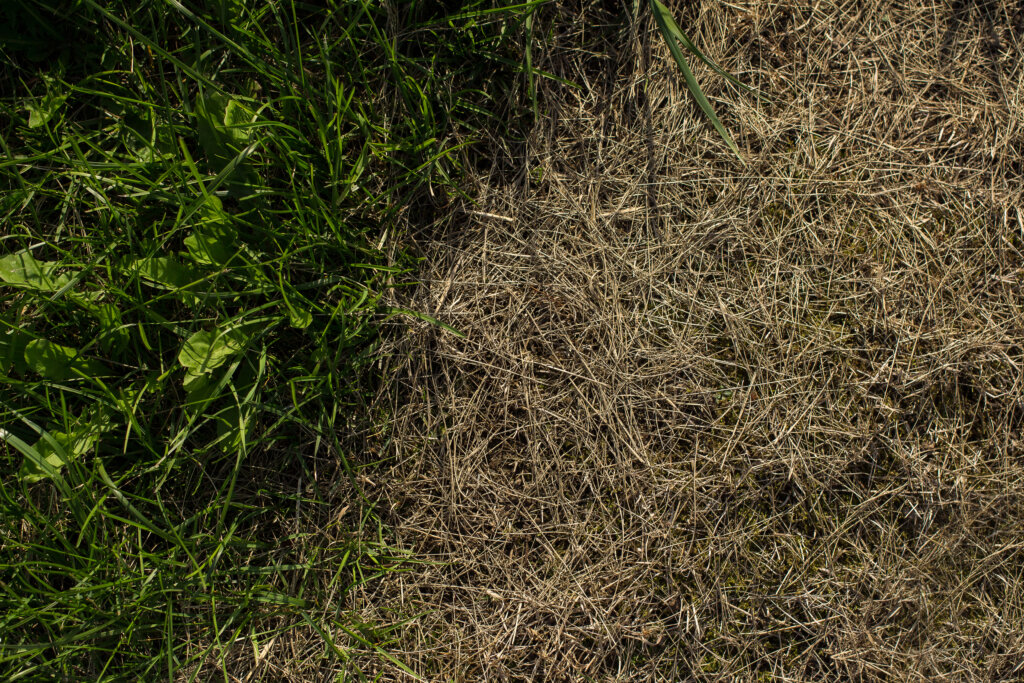
Terra’s on-site analysis identifies which specific conditions are driving infection on your property, not a zip-code-level assumption. If you’re seeing circular brown patches, schedule a free on-site assessment with a state-certified Terra technician before the spread continues.
Summer dormancy is a survival mechanism, not a disease. Kentucky Bluegrass and Tall Fescue turn brown when soil moisture depletes and temperatures hold above 80°F, but crowns and roots stay alive. Maintaining consistent yard maintenance practices throughout the spring can help your lawn handle this stress better. Uniform straw color across the entire yard, blades that fold lengthwise without any lesions, and roots that stay anchored on the tug test all confirm dormancy. Isolated circular dead patches with lesioned blades mean something else entirely.
The Terra Intervention: Curative and Preventative Turf Disease Control
Once brown patch fungus is established in the leaf tissue and thatch layer, changing the irrigation schedule won’t stop it. The mycelial network is already working. Professional intervention is the only way to halt the pathogen before it destroys the root system. If the roots are already gone, repairing the bare patches requires proper preparation, as detailed in our Can I Just Throw Grass Seed Down on Existing Lawn? 2025 Expert Guide.
Terra’s Turf Disease Control Program was built for the fungal outbreaks common to Montgomery, Chester, Delaware, Lancaster, Berks, Lehigh, and Bucks counties. An in-house agronomist with a degree from Delaware Valley University and 15-plus years of golf-course management experience oversees every protocol. Every technician who steps onto your property is individually state-certified and a direct Terra employee, not a seasonal hire from a staffing agency.
Catching Early Signs Before Brown Patch Spreads
The window between the first early signs of infection and full patch expansion is short. Fungicide applied at the first visible circle, before patches coalesce, delivers the fastest recovery.
Terra uses Propiconazole, a systemic fungicide in the DMI class. DMI stands for Demethylation Inhibitor: it blocks the fungus’s ability to build its own cell structure from within, the same chemistry used on professional golf courses. Unlike contact fungicides that coat the blade surface and wash off in rain, Propiconazole absorbs into the turfgrass tissue and moves upward through the plant’s xylem (the internal water-transport channel). It shuts down the fungus’s ability to maintain its own cell walls; without that process, the fungal cells collapse, and the spread stops.
Most active spread slows significantly within 24 to 48 hours of application, and the plant retains a residual preventative barrier for up to 21 days.
Granular azoxystrobin treatments, spread evenly across the lawn, cover both contact and systemic pathways during peak disease pressure.
One properly timed professional application does more to stop an active infection than two weeks of adjusted watering schedules. The chemistry works inside the plant, not on the surface, which is why retail fungicides consistently underdeliver on an established infection.
Cellular Fortification: What Generic Lawn Care Skips
Stopping the active fungus is the first phase. The second is fortifying the weakened turfgrass before it gets hit again.
Terra’s protocol incorporates potassium phosphite and potassium silicate as part of its biochemical treatment approach, which you can learn more about by exploring humic acid and its impact on lawn health. Phosphite forces the plant to produce more cellular energy, the kind that drives deeper root growth and switches on the grass’s built-in immune response (called Systemic Acquired Resistance, or SAR) against secondary infections. Potassium silicate gets deposited directly inside the grass blade, essentially armoring the leaf tissue against heat and future fungal attacks.
This is the same approach used on golf courses in Montgomery and Chester counties, applied at the residential level. It won’t show up as a line item on a competitor’s quote, but Terra customers notice the difference when their lawn comes through July in better shape than it went in.
Preventing Recurrence After Treatment
Three variables determine whether fungal disease takes hold again next summer, and all three are controllable. Terra’s technicians walk homeowners through these after every treatment visit.
Long-Term Recovery: Why Aeration, Overseeding, and Balanced Nutrition Matter
Stopping the active infection doesn’t fix the structural damage. Brown patch leaves thinned turf and bare areas behind, and bare areas don’t stay bare. Crabgrass, goosegrass, and nutsedge move in fast wherever the canopy has gaps. Knowing how to get rid of onion grass and other aggressive weeds before fall is what separates a lawn that fully recovers from one that just survives.
Core aeration relieves compacted soil, breaks up the low-oxygen surface conditions where sclerotia overwinter, and allows air, water, and nutrients to reach the root system before the next growing season. If you want to understand how core aeration works and when to schedule it for your specific property, Terra’s aeration guide walks through the full process for PA homeowners.
The right window for fall aeration in Pennsylvania aligns with cooling soil temperatures across all of Terra’s service counties, giving the turf time to expand its root mass before dormancy sets in. Overseeding immediately follows.
Terra uses certified Turf-Type Tall Fescue blends built for the mid-Atlantic climate: deeper roots, stronger drought tolerance, and better disease resistance than older Perennial Ryegrass varieties. Seeding directly into freshly aerated plugs maximizes germination and closes the canopy gaps before weeds establish. Knowing how to reseed lawn in fall (step-by-step guide for a healthier yard) is essential for repairing this summer damage.
Core aeration and overseeding feed directly into Terra’s program, and what that 6-step program covers across every season goes well beyond disease recovery: it’s a full-year agronomic framework built to keep Tri-State lawns balanced, resilient, and ahead of the fungal pressure that returns every summer. Terra maintains a 95% customer retention rate, more than 25 points above the industry average. The homeowners who stay on this program are the ones with the nicest lawns on the block.
Don’t Wait for Dead Patches to Spread
Ignoring expanding brown patches during a Tri-State summer means permanent root damage. Generic retail fertilizers won’t reverse an active fungal infection. Understanding when is it too cold to water a lawn is important, but in summer, running the irrigation system at night will accelerate the disease.
Schedule an on-site lawn analysis with Terra Lawn Care today. Get a free estimate from a state-certified technician and secure the curative treatment required to stop the summer fungus before it reaches the roots. Terra’s team handles lawn disease, aeration, overseeding, and long-term turf health all under one roof, with no subcontractors and no guesswork.
Been with Terra for a little more than one full year and the results are showing. Thicker, greener lawn with fewer bare spots.
For homeowners who want to get ahead of seasonal damage before it starts, Terra’s full lawn care services include the year-round agronomic programs that keep Tri-State lawns disease-resistant, properly fed, and structurally sound through every season of the Delaware Valley climate. Call 610-275-2170 today.