Lawn grubs are one of the most common causes of sudden lawn decline in the Tri-State area. One week, your grass looks fine. Next, you’re staring at brown patches, spongy turf, and skunks tearing up the yard overnight.
Most lawn care companies treat them as a one-time pest issue. At Terra Lawn Care, our in-house agronomist, with over 15 years managing golf course turf, treats these pests as part of the soil system. That difference matters in PA, NJ, and DE, where cool-season grasses face summer heat, compacted soil, and heavy beetle pressure.
What Are Lawn Grubs and How Do They Damage Your Lawn?
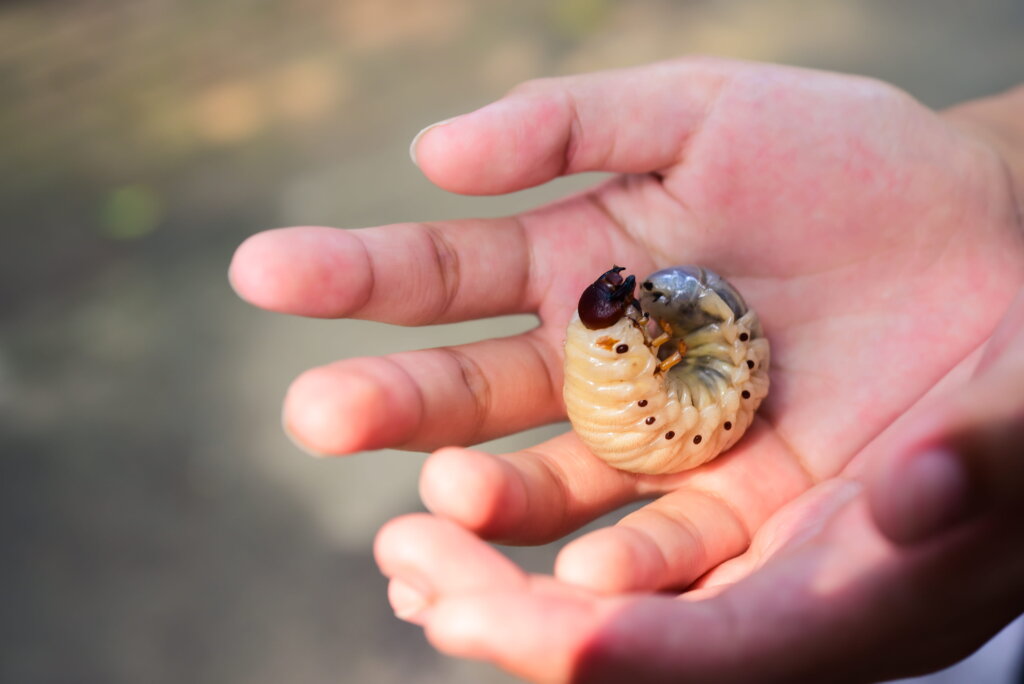
Lawn grubs are the larval stage of scarab beetles, including Japanese beetles, June beetles, European chafers, and Oriental beetles, common in the Tri-State region.
These white grubs have soft, C-shaped bodies with brown heads and three pairs of legs. Most range from ½ inch to over an inch long. What makes them destructive: grubs feed on grass roots.
When these pests feed in the root zone, turf loses its ability to absorb water and nutrients. Even well-watered lawns can wilt, turn brown, and die. Grubs are just one of several pests that can damage your outdoor spaces. Learn more about effective outdoor pest control strategies that protect your entire property.
Common signs
- Irregular brown patches that don’t recover with irrigation
- Spongy turf underfoot
- Grass that pulls up like carpet
- Increased digging by skunks, raccoons, or birds
- Dead patches in late summer or early fall
Pro Tip: If the turf peels back easily during a shovel test, the roots are already gone. That’s an active infestation, not drought stress. While you’re protecting your lawn from grubs, don’t overlook other pests—mosquitoes, fleas, and ticks can make your yard uncomfortable even when the grass is healthy.
How to Confirm a Lawn Grub Problem
Cut three sides of a one-square-foot section of turf and fold it back. Check the soil and root zone for white grubs. According to Michigan State University Extension, a lawn’s ability to survive grubs depends heavily on moisture:
- Unwatered lawns: 5–10 grubs per square foot can cause noticeable damage.
- Irrigated, healthy lawns: Can tolerate up to 20 root-feeding larvae before intervention is necessary.
If your lawn is stressed, under-watered, or already showing signs of damage, treat at lower thresholds (6–10 larvae). Well-maintained, irrigated turf can wait until populations exceed 10–15 per square foot.
The Lawn Grub Life Cycle in 2026
In PA, NJ, and DE, most scarab beetles follow a one-year life cycle, though June beetles may take two to three years. Understanding this timing is the difference between effective grub control and wasted money.
Adult beetles emerge in early summer. Japanese beetles, June bugs, and other species feed on ornamental plants and trees. After mating, females lay eggs in irrigated lawns over two to three weeks in early to mid-summer.
Eggs hatch about two weeks later, often mid-July to early August. Newly hatched grubs begin feeding immediately, with peak feeding in late summer through early fall. This is when these pests are most active and most damaging.
Grubs remain a few inches below the soil surface, feeding on plant roots. As temperatures drop, older grubs burrow deeper to overwinter. In spring, they move back to the root zone, feed briefly, then pupate.
Treatment vs. Prevention
Curative treatments
When grub damage appears and grubs are actively feeding, curative treatments include trichlorfon-based chemical insecticides and carbaryl. These kill grubs quickly but must be watered into the soil immediately. Timing matters; once grubs stop feeding in late fall, curative treatments lose effectiveness.
Curative treatment is reactive. It stops further damage but doesn’t address why grub populations were high in the first place.
Preventative grub control
Preventive timing depends on the active ingredient. Chlorantraniliprole (Acelepryn) should be applied earlier, mid-April through May, because it takes 60–90 days to fully activate in the soil. Imidacloprid is most effective when applied closer to egg hatch in late June or July to avoid premature degradation before grubs emerge.
According to the National Pesticide Information Center, chlorantraniliprole is classified by the EPA as a reduced-risk insecticide. It targets muscle receptors found in grubs but not in humans or pets. When applied according to the label, it is rated low-toxicity to honeybees and many beneficial insects, which is why it has become the preferred option for residential preventative grub control.
Why DIY Grub Control Often Fails
Homeowners usually struggle to control grubs for three reasons: mistimed applications, incorrect product selection, and uneven coverage. Applying products after eggs hatch or once instar grubs stop feeding leads to poor results. Using the wrong active ingredient matters, too; some products target only certain beetle larvae, leaving others untouched. Missed areas allow a grub infestation to continue spreading, even after treatment.
Store-bought solutions also don’t consider local conditions. In PA, NJ, and DE, multiple white grub species can exist in the same lawn, each with a different life cycle. Products applied without considering soil type, irrigation patterns, or beetle pressure often fall short, especially in stressed turf where grubs eat roots more aggressively.
For detailed strategies on effective grub elimination and control, a professional assessment of your specific lawn conditions is critical.
Chemical Insecticides
Preventative grub control products are the most reliable way to prevent grubs when applied at the correct time and watered in properly. Used incorrectly, they won’t stop lawn damage.
Applied professionally, they protect the entire lawn through peak beetle activity and help maintain a healthy lawn even during summer stress.
Milky Spore
According to The Ohio State University, Milky Spore is highly effective against Japanese Beetle grubs; however, it is species-specific. Because it provides no control over the European Chafer or Oriental Beetle, both common in the Tri-State area, it often leaves lawns vulnerable to significant damage when multiple grub species are present.
Beneficial Nematodes
Beneficial nematodes, also known as insect parasitic nematodes, can reduce grub populations when applied in late summer or early fall. Species selection is critical. Heterorhabditis bacteriophora (Hb) is recommended for the Tri-State because it seeks out grubs in the soil and suppresses current infestations when conditions are right.
The Terra Lawn Care Difference
Terra Lawn Care doesn’t use subcontractors. Every technician is state-certified in the Tri-State area.
Our agronomist-led approach: accurate species identification, proper timing based on local weather, preventative products applied before damage occurs, turf recovery through aeration and overseeding, and soil health improvements for long-term results. Our professional pest control services go beyond grubs to protect your lawn from the full range of turf-damaging insects.
Our 95% client retention rate: fewer grubs, healthier roots, lawns that stay green year after year.
Protect Your Lawn Before Grubs Do
Grub damage worsens quickly during summer heat, especially in stressed cool-season grasses. If you suspect lawn grubs or want to prevent them before they hatch, get a free estimate from the Tri-State’s leading lawn experts.
Frequently Asked Questions About Lawn Grubs
For an active grub infestation in late summer or early fall, curative treatments target grubs while they are feeding and reduce populations quickly.
For long-term control, preventative grub control products applied in mid-spring to early summer stop eggs from developing. Maintaining balanced organic matter, proper watering, and encouraging beneficial insects helps keep your turf healthy and less attractive to egg-laying beetles.
Dish soap kills some grubs if it reaches them directly, but it’s not reliable. Grubs are soft-bodied, living several inches below the soil surface, so soap rarely penetrates deep enough.
Soap can irritate grubs and bring them closer to the surface in the early morning, which may help detect their presence. However, it doesn’t prevent future infestations. Professional treatments or properly timed organic options are far more effective.
Look for irregular brown patches that don’t recover with watering. Grass wilts because grubs feed on roots. The turf feels spongy and can peel up easily, revealing white grubs with their characteristic C-shaped bodies.
Skunks, raccoons, and birds digging into lawns are another sign of active grub activity. In stressed turf, large sections of grass may die during summer heat or dry periods.
For prevention, mid-spring through early summer is ideal, before grub eggs hatch. This is especially critical for controlling the annual white grub species.
For active grub damage, late summer or early fall works best while grubs are still feeding near the soil surface. Correct timing prevents lawn damage and supports turf recovery heading into cooler months.